There is no single dimensional tolerance that is correct for every point on every soft bag. A laptop pocket must fit a defined device. Two shoulder straps may need to match each other closely. Overall depth on an unfilled gusseted duffel can change with how the bag is placed and how the fabric relaxes.
Set tolerances by function, construction, material behavior and measurement method. Start by defining exactly where and under what condition the dimension is measured. Then decide how much variation the product can accept without harming fit, operation, appearance or packing.
A tight tolerance is not automatically a high-quality specification. If the measurement method is ambiguous or the construction cannot hold it consistently, the result will be repeated disagreement rather than better bags.
Table of Contents
Why soft bags do not measure like rigid parts
Fabric assemblies bend, compress and relax. Foam can recover after packing. A gusset can fold inward or outward. Binding and piping can obscure the true panel edge. A curved top line changes height depending on the point selected.
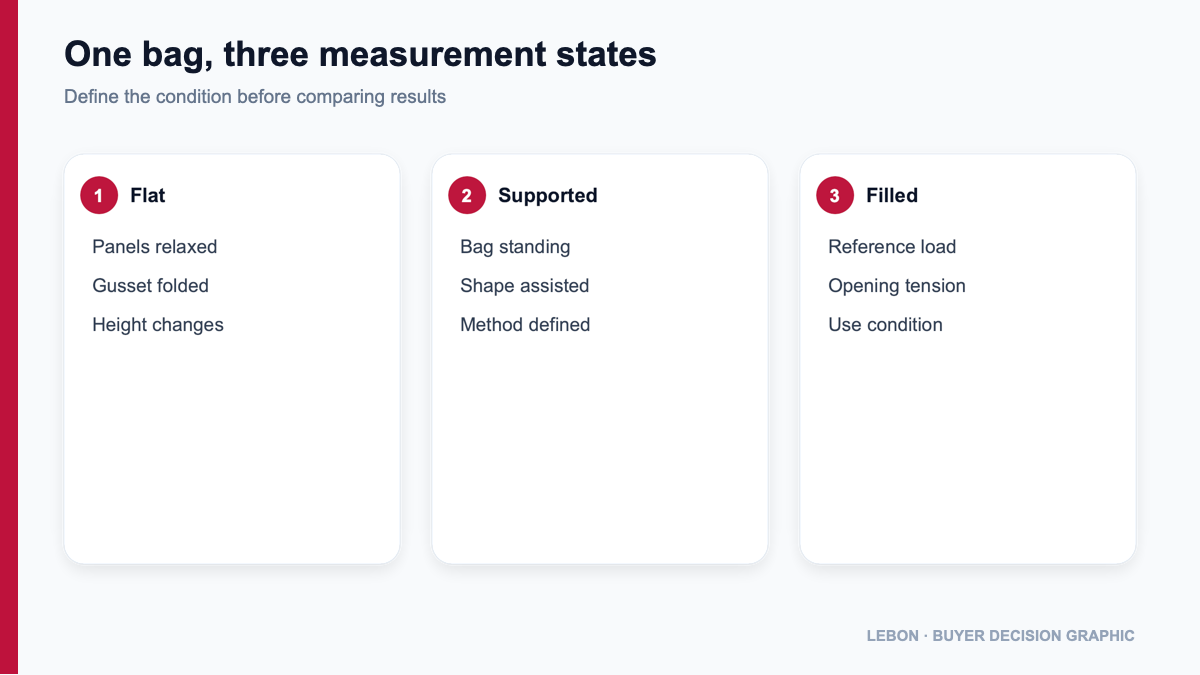
Measurement variation can come from:
- the point selected as the edge or seam landmark;
- whether the bag is flat, supported, naturally standing or filled;
- whether zippers, compression straps or closures are open or closed;
- whether flexible panels are smoothed, stretched or left relaxed;
- foam thickness and recovery;
- material stretch, shrinkage, coating and lamination behavior;
- seam allowance and sewing accumulation;
- the geometry of curves, gussets, piping and binding;
- the measuring tool and operator technique.
Before treating a result as a manufacturing defect, repeat the measurement using the agreed method. If buyer and factory methods produce different results on the same sample, the first correction belongs in the measurement specification.
Classify every point by what it controls
Do not assign one blanket tolerance to all dimensions. Divide points of measure into functional groups.
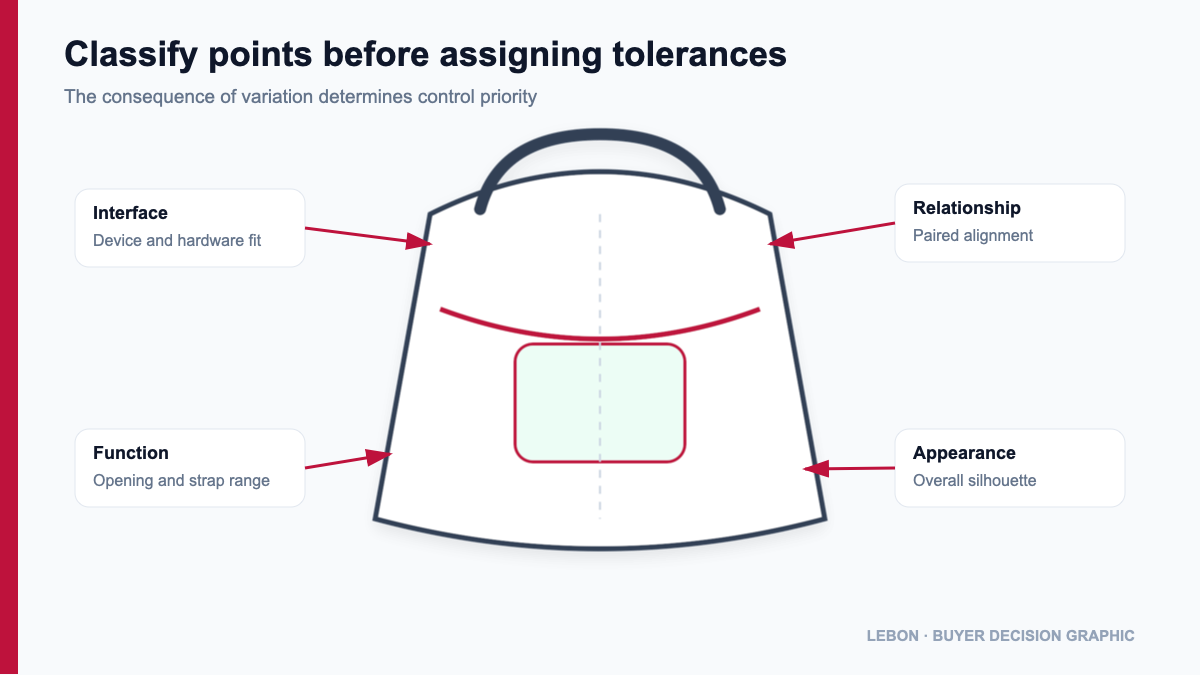
Interface-critical dimensions
These control whether another object or component fits or aligns. Examples include:
- laptop-pocket usable width and height;
- sleeve opening for a defined bottle or tool;
- buckle and webbing compatibility;
- trolley-sleeve fit over a specified handle;
- zipper or frame interface length;
- label or barcode location required by downstream equipment.
Set these from the actual interface requirement. Include allowance for the product, lining, padding and access task. Do not copy the nominal device size directly without considering how it is inserted and removed.
Function-critical dimensions
These affect use even when there is no mating part. Examples include handle drop, strap adjustment range, pocket opening, zipper access, divider position and base width needed for stability.
The acceptable variation should be linked to a use check. A dimension can remain within a number and still fail if the opening cannot perform its task.
Symmetry and relationship dimensions
Some features matter because they match each other: left and right strap length, handle position relative to center, paired pocket height or logo alignment to a panel.
For these, specify both the absolute location and the allowed difference between paired features when that difference is more visible or functional than the overall dimension.
Overall appearance dimensions
Overall width, height and depth influence silhouette, capacity, packing and retail presentation. On a soft bag, define the landmarks and measurement state carefully. An overall tolerance may need to differ by size, structure or axis.
Reference dimensions
A derived or informational dimension should not create a second conflicting acceptance requirement. Mark it “reference” if it is calculated from controlled dimensions or included only to help understand the drawing.
Build the tolerance from the product requirement backward
Use this sequence instead of starting with an arbitrary plus/minus value.
1. Define the consequence of variation
Ask what fails if the point is too small, too large, off-center or unmatched. The consequence may be:
- the intended contents do not fit;
- the zipper or buckle is placed under tension;
- the user cannot access a pocket;
- a pair of straps feels uneven;
- the bag no longer fits a carton or fixture;
- the appearance no longer matches the approved sample;
- an artwork or label misses its required zone.
If no meaningful consequence can be identified, the point may not need a tight acceptance tolerance.
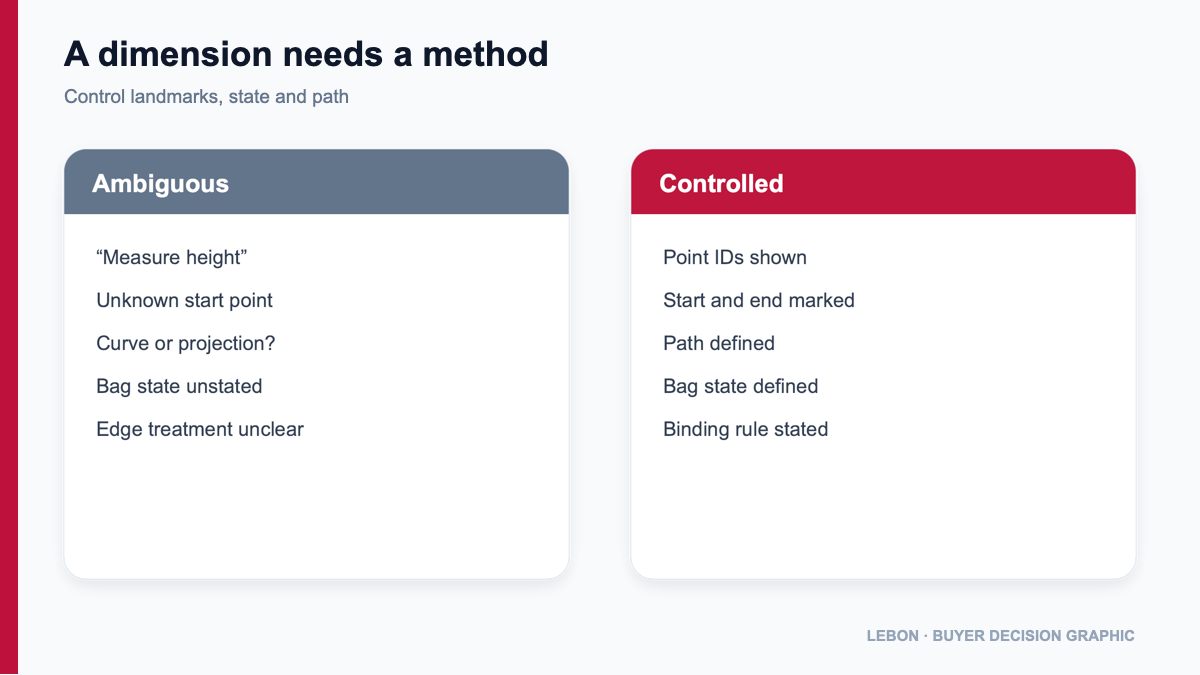
2. Define the measurement method
Show the start and end landmarks on an annotated image or drawing. State:
- bag state and orientation;
- closure and strap condition;
- whether the dimension follows a curve or is a straight projection;
- whether piping or binding is included;
- whether the material is smoothed, lightly tensioned or left relaxed;
- tool and reading precision where relevant;
- conditioning requirement where material behavior makes it necessary.
3. Review the construction path
Trace how cutting, lamination, sewing and assembly contribute to the finished point. A dimension crossing several seams can accumulate more variation than a short location measured within one stable panel. Curves, elastic, thick foam and flexible gussets need particular care.
This does not mean accepting unlimited variation. It tells the development team where pattern, fixture, notch, work method or measurement control may need improvement.
4. Use representative samples to test the method
Measure development samples more than once and, when possible, have buyer and supplier compare technique. If the same unit produces materially different readings between operators, fix the method before setting a narrow limit.
Do not claim process capability from one hand-made prototype. Production capability needs representative process data. If that data is not yet available, mark the initial tolerance as provisional and confirm it during a defined pilot or early-production review.
5. Approve the tolerance with the product, not after it
Tolerance decisions affect pattern, construction, material, inspection time and cost. Review critical points during development. Adding a rigid tolerance after the sample is approved can create a requirement the product was never designed to hold.
A measurement sheet that factories can use
Each controlled point should include:
- point-of-measure ID;
- feature name;
- annotated start and end landmarks;
- target dimension and unit;
- upper and lower limit or stated approval rule;
- bag state and orientation;
- measurement path and tool;
- whether the point is interface-, function-, symmetry- or appearance-critical;
- sample result and status;
- revision and comments.
For asymmetric limits, record the upper and lower limit separately. A pocket may tolerate extra clearance more easily than insufficient clearance. Do not force a symmetrical plus/minus format when the functional risk is one-sided.
Avoid these common tolerance mistakes
Applying one tolerance to every point
It is simple to type but ignores function and construction. It can be too loose for a device pocket and unnecessarily tight for an unfilled overall depth.
Copying apparel or another supplier’s tolerance table
A different product, material, construction and measurement method may not transfer. Standards can provide test or inspection methods, but the buyer and manufacturer still need product-specific acceptance criteria.
Specifying more decimal places than the method can support
Extra digits do not create accuracy. Align the recorded precision with the tool, material behavior and decision being made.
Measuring through compressible features inconsistently
Foam, piping and binding change the apparent edge. State whether they are included and how much pressure, if any, is applied.
Using the approved sample as the only limit
“Same as sample” helps communicate shape and workmanship, but it does not tell inspectors how much variation is acceptable. Define measurable critical points and use the sample as an appearance reference.
Rejecting from one disputed reading
When a result is near a limit, confirm the unit, method, landmark and instrument. Then apply the agreed sampling and disposition process. Do not average away a functional failure, but do not classify method variation as product variation either.
How to handle a tolerance disagreement
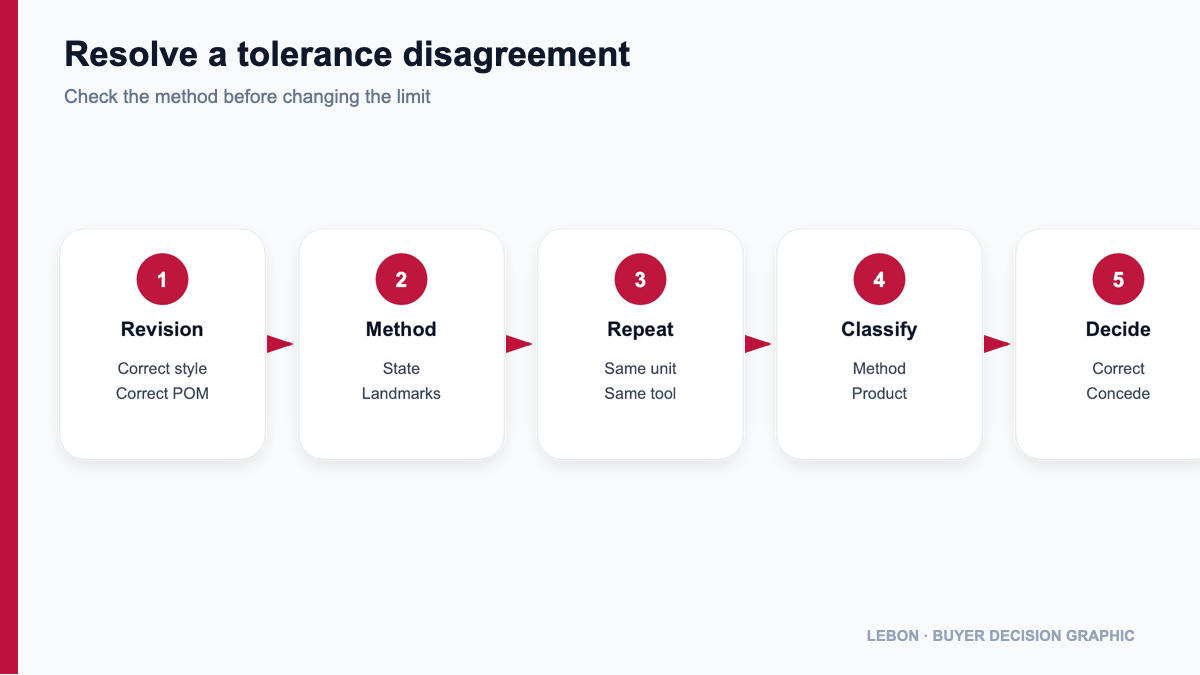
Use this order:
- Confirm product code, revision and point-of-measure ID.
- Confirm bag state, orientation, closure condition and landmarks.
- Re-measure the same unit with the agreed method.
- Compare buyer and supplier readings on the same physical unit if possible.
- Determine whether the issue is method variation, product variation or both.
- Check the functional consequence, not only the numerical difference.
- Decide correction, concession or specification revision through the agreed change process.
- Update drawings, instructions and inspection records if the method was unclear.
A concession for one lot should not silently rewrite the product specification. Record its scope and the permanent corrective action separately.
What buyers should send before asking for tolerances
Give the supplier:
- intended contents and critical fit dimensions;
- annotated points of measure;
- bag state and measurement method;
- functional checks for critical features;
- material and construction direction;
- packaging or fixture constraints;
- appearance relationships that matter, such as paired alignment;
- any required external test or customer standard;
- which points are provisional until representative samples are reviewed.
If you do not yet know the numerical tolerance, ask the supplier for a proposal tied to the sample and manufacturing method. Require the reasoning and validation plan, not a copied generic table.
Next step for bag quality planning
If a buyer and factory are getting different measurements from the same sample, send the tech pack page, annotated photos and both measurement methods through our product inquiry form. The measurement condition should be resolved before tightening limits or rejecting production.
Related resources:
- Bag sampling and quality control process
- Why a bag drawing is not enough for production
- Custom bag development and inquiry checklist
- Custom bag materials guide
Technical references:
- AATCC directory of textile test methods and evaluation procedures
- ISO guidance on control of documented information