Two factories can receive the same bag drawing and return very different prices without either quotation being mathematically wrong. The more common problem is that they have priced different interpretations of an incomplete specification.
One supplier may assume stock polyester, a standard zipper, light reinforcement and basic export packing. Another may allow for a specified coating, branded hardware, reinforced stress points, individual retail packaging and additional inspection. The outer silhouette can look identical while the material, labor and commercial scope are not.
Before negotiating, normalize the quotations. The useful question is not “Which factory is cheaper?” It is “What exact product and delivery responsibility does each price buy?”
Table of Contents
The drawing is the same, but the manufacturing assumptions are not
A rendering or reference sample normally communicates appearance better than production scope. Unless the request for quotation defines the details, each supplier must fill gaps with its own assumptions.
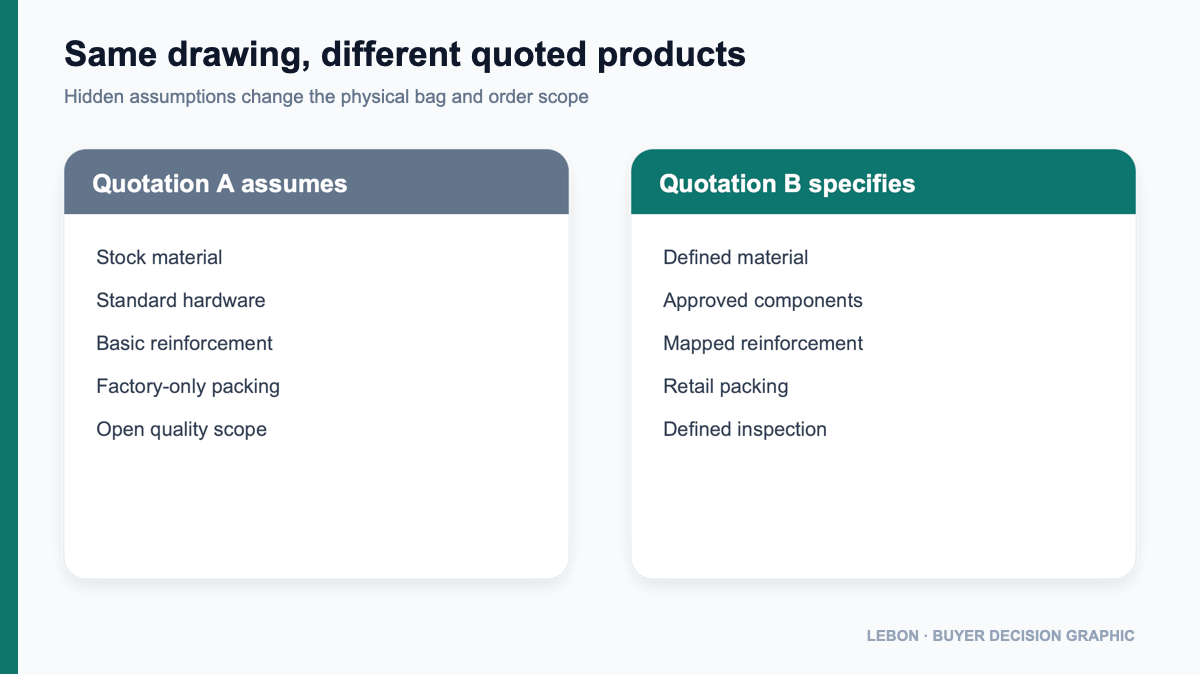
The gaps usually sit in six areas:
- Materials: fiber, construction, denier or weight, coating, color source, lining, foam, reinforcement and approved equivalents.
- Components: zipper construction and size, slider, buckle, hook, webbing, label and hardware finish.
- Construction: seam type, binding, edge finishing, stitch access, reinforcement method and internal organization.
- Decoration: artwork size, location, color count, print or embroidery method, backing and setup requirements.
- Quality and approval: sample stages, inspection scope, measurement method, test requirements and defect criteria.
- Commercial scope: quantity, packaging, tooling, payment assumptions, delivery location and trade term.
A factory that receives an open specification may quote the lowest reasonable interpretation, the safest interpretation, or the version it normally makes. Those are different products even when the proposal uses the same drawing.
Material names alone do not create an equal comparison
“600D polyester” does not fully define a bag fabric. Two options described that way can differ in yarn construction, finished weight, weave density, coating, backing, hand feel, color process and usable width. The same problem applies to “nylon lining,” “No. 5 zipper,” “metal buckle” and “EVA foam.”
Ask each supplier to record the specification behind the price. If an exact material is not yet selected, label the quoted option as an assumption and request a swatch with traceable identification. Do not allow a sample swatch and the written quotation to become separate, unconnected references.
The material question is not always “Which is better?” A less expensive stock fabric may be sufficient for a promotional tote. A custom color, heavier coating or branded component may be justified for a retail product with stricter appearance and performance requirements. The quotation should expose that trade-off.
Construction changes labor even when the bag looks the same
Bag cost is affected by the sequence and accessibility of operations, not just the number of visible features. A pocket sewn before the shell is closed may be straightforward. A similar pocket added in a restricted location after several layers are assembled can require more handling and slower sewing.
Other construction details that commonly change the work content include:
- whether seam allowances are bound, folded or left concealed;
- whether reinforcement is a bar tack, box stitch, backing patch or combined construction;
- whether foam stops before the seam or continues into a bulky intersection;
- whether a curved opening can be sewn in a stable, repeatable sequence;
- whether webbing ends are hidden between layers or finished visibly;
- whether a logo is applied to a flat panel or to a partly assembled component.
A supplier may simplify an unclear detail to make it manufacturable. Another may retain the visual intent with an extra pattern piece or operation. Request a construction description or annotated section view for any feature with a meaningful cost or performance effect.
Packaging and quality scope can move outside the quoted unit price
Check whether the unit price includes the approved polybag, tissue, hangtag, barcode label, desiccant, carton specification and carton marking. Also check whether setup charges, molds, printing screens, samples, testing, inspection or spare components are separate.
This is not an argument that every service must be included. It is an argument for placing every cost in the same comparison frame.
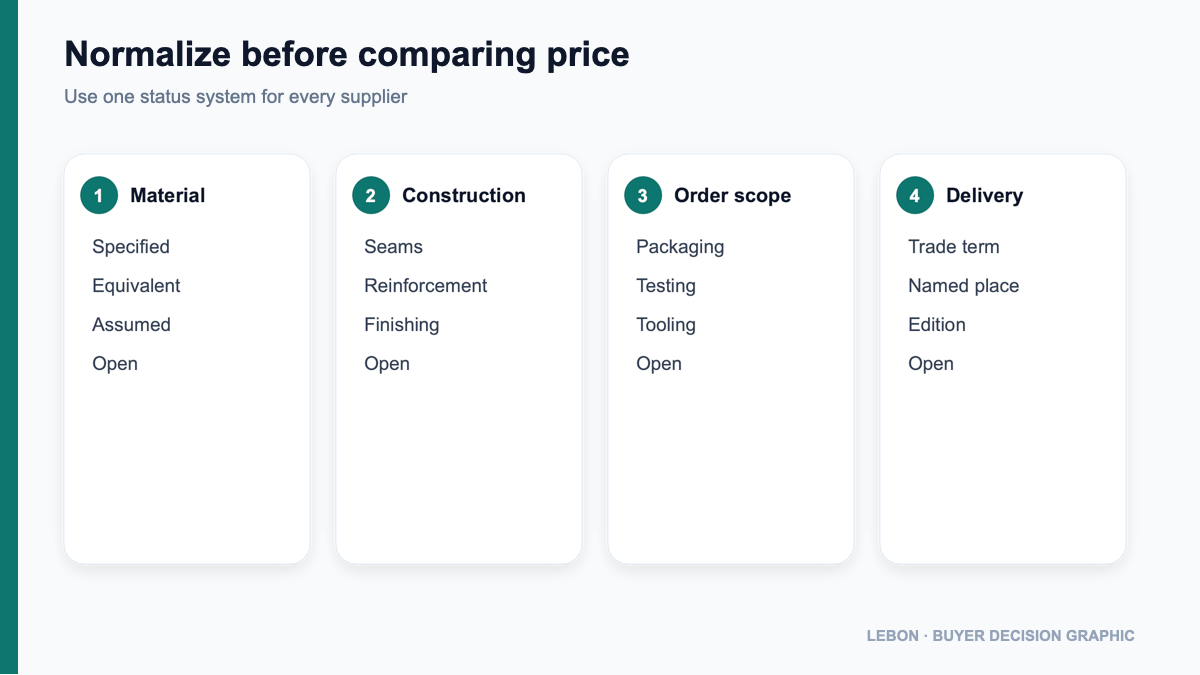
Quality language also needs definition. “QC included” does not explain which requirements are checked, at what stage, with what method, or what record the buyer receives. If third-party inspection or laboratory testing is required, state the responsible party, sample stage and acceptance criteria before comparing prices.
Trade terms can make identical factory prices commercially different
The delivery term and named place affect which transport, handling, export, insurance and risk responsibilities sit with the buyer or seller. A quotation marked only “FOB” is incomplete without a named port and the applicable Incoterms® edition. EXW, FCA, FOB, CIF, DAP and DDP are not interchangeable price labels.
Incoterms® rules allocate defined obligations, costs and risk between buyer and seller. They do not define product quality, payment timing or transfer of ownership. Record those commercial terms separately.
How to normalize two bag quotations
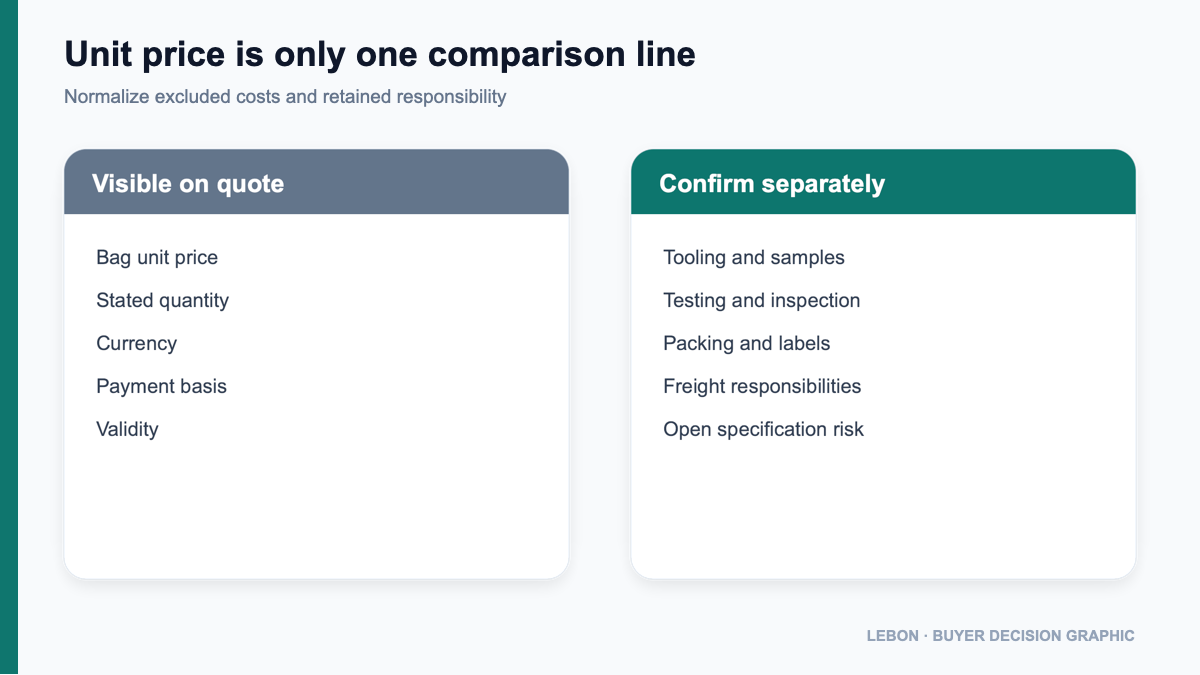
Use one comparison sheet and follow this sequence.
1. Freeze the RFQ version
Give every supplier the same dated drawing, bill of materials, measurement sheet, artwork, packaging requirement, quantity breakdown and delivery request. If a supplier receives a later revision, reissue it to the others before comparing.
2. Separate requirements from assumptions
Mark each field as one of the following:
- Specified: the buyer has defined it;
- Supplier proposal: the factory recommends an alternative;
- Assumed for quotation: a temporary basis that still requires approval;
- Excluded: not covered by the price;
- Open: no decision or usable answer yet.
3. Compare the physical product first
Normalize material, component and construction lines before comparing commercial terms. If Supplier A priced a branded zipper and Supplier B priced an unspecified equivalent, ask one or both to requote the same choice.
4. Compare the order scope
Align quantity by color and style, sample or tooling charges, packaging, testing, inspection, spare parts, delivery term, named place and quotation validity. Do not mix a factory-only price with a delivered price.
5. Record risk, not just cost
Note which specifications remain open, which alternatives are untested and which items have long or uncertain sourcing paths. This does not justify a vague high price. It prevents an artificially precise low price from being treated as firm.
Questions to send back before choosing a supplier
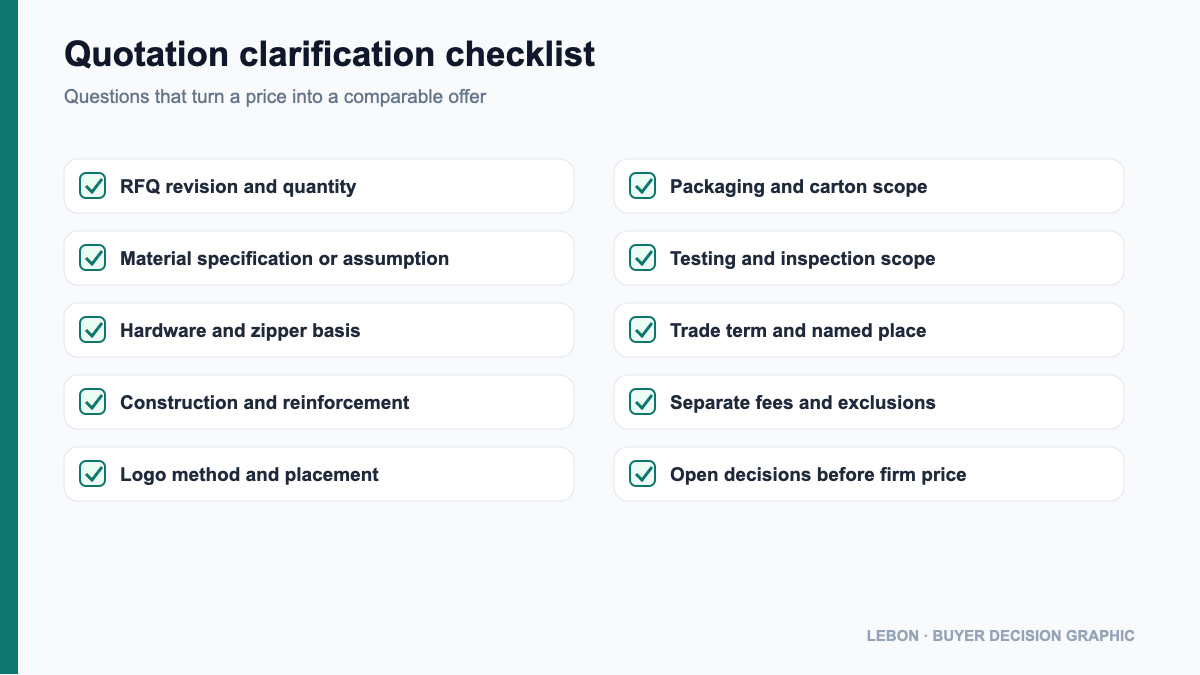
Ask each factory to confirm:
- Which file revision and quantity breakdown did you quote?
- Which materials and components are exact specifications, and which are assumed equivalents?
- Are lining, reinforcement, binding and internal construction included as drawn?
- What logo method, size and color count are included?
- Which packaging components and carton requirements are included?
- Which sample, tooling, testing and inspection costs are separate?
- What delivery rule, named place and Incoterms® edition apply?
- Which requirements remain open before the price can become firm?
- Which proposed changes would reduce cost without changing the required function?
The quality of the answers also tells you something about the supplier. A useful reply connects the price to a product decision. “This option is cheaper” is incomplete; “this option removes a separate reinforcement piece but changes the handle-load path” is a decision you can evaluate.
When should you accept the higher quotation?
Do not accept it simply because it is higher, and do not reject it simply because it is higher. Choose it when the normalized comparison shows that it buys requirements you actually need, reduces a material sourcing or production risk that matters, or includes commercial scope that would otherwise be paid elsewhere.
Choose the lower quotation when the physical specification and order scope are genuinely equivalent and the supplier can support the required quality and delivery controls. The cheaper option may be fully sufficient.
If the prices remain far apart after normalization, request a cost-impact review by section—body material, lining, hardware, construction, branding and packaging. You do not need a factory’s confidential internal costing formula to identify which buyer decisions drive the difference.
What to send for a comparable custom bag quotation
Prepare one controlled RFQ package containing:
- dated drawings with revision number;
- finished dimensions and defined measurement points;
- bill of materials with approved alternatives clearly marked;
- construction and reinforcement callouts;
- artwork files, colors, scale and placement;
- order quantity by style and color;
- packaging and labeling specification;
- required sample, inspection and testing scope;
- delivery destination, requested trade term and named place;
- a list of open decisions where you want the manufacturer’s recommendation.
If your quotation package is still incomplete, say so. A budgetary quotation based on declared assumptions is more useful than a supposedly firm price built on invisible guesses.
التالي step for a custom bag project
If two quotations cannot be compared line by line, send us the drawing, bill of materials, quantity breakdown and the assumptions you want held constant through the product inquiry form. We can review what needs to be specified before sampling or requotation.
Related resources:
- Custom bag development and inquiry checklist
- Custom bag materials guide
- How to choose a custom bag factory
- Custom bag product categories
Technical references:
- PTC overview of a manufacturing bill of materials
- ICC explanation of what Incoterms® rules allocate
- ASQ supplier selection and total-cost criteria