A supplier does not prove technical understanding by replying quickly, agreeing with every request or showing a large catalog. The stronger evidence is what happens when the specification is incomplete or contradictory.
Does the supplier identify the missing decision? Can they explain how material, pattern and sewing choices affect the intended use? Do they separate a recommendation from an assumption and record the approved result for production?
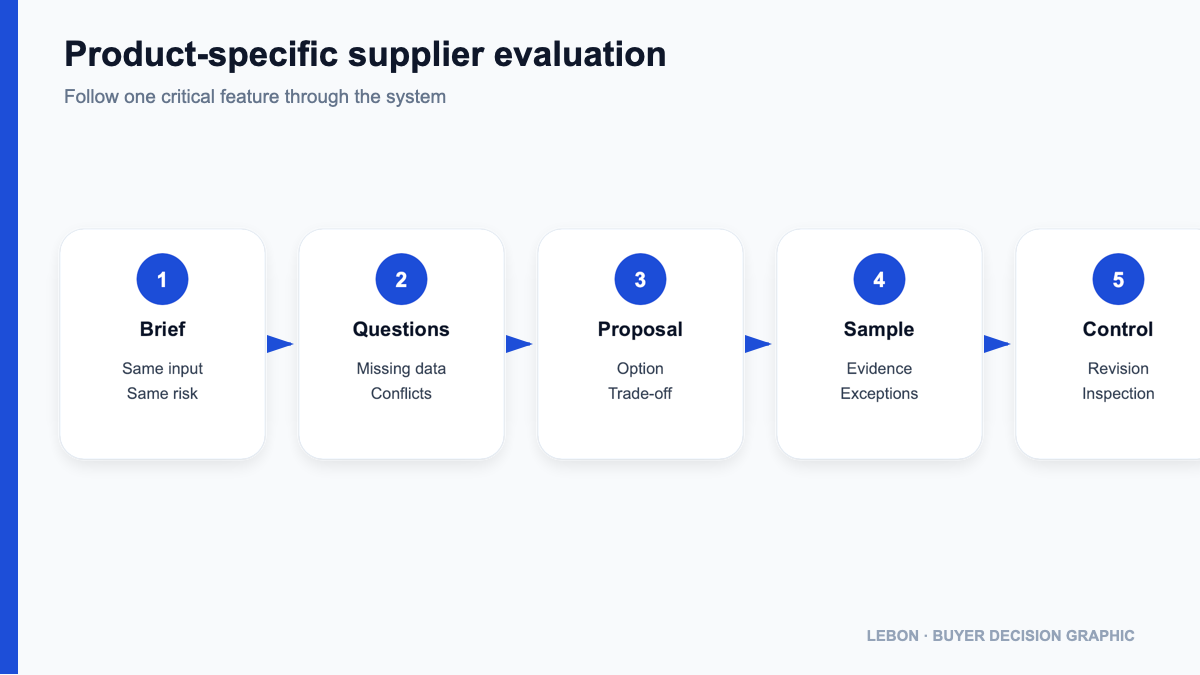
You can test this before committing to bulk. Give each shortlisted supplier the same product brief, then compare the technical questions, proposed options, sample plan and risk controls in their response. The purpose is not to find the supplier who asks the most questions. It is to find the supplier who asks the questions that change product performance, manufacturability or approval risk.
Table of Contents
Look for evidence at the product level
General claims such as “strict QC,” “rich experience” or “professional R&D team” are not enough. Ask the supplier to work through your product.
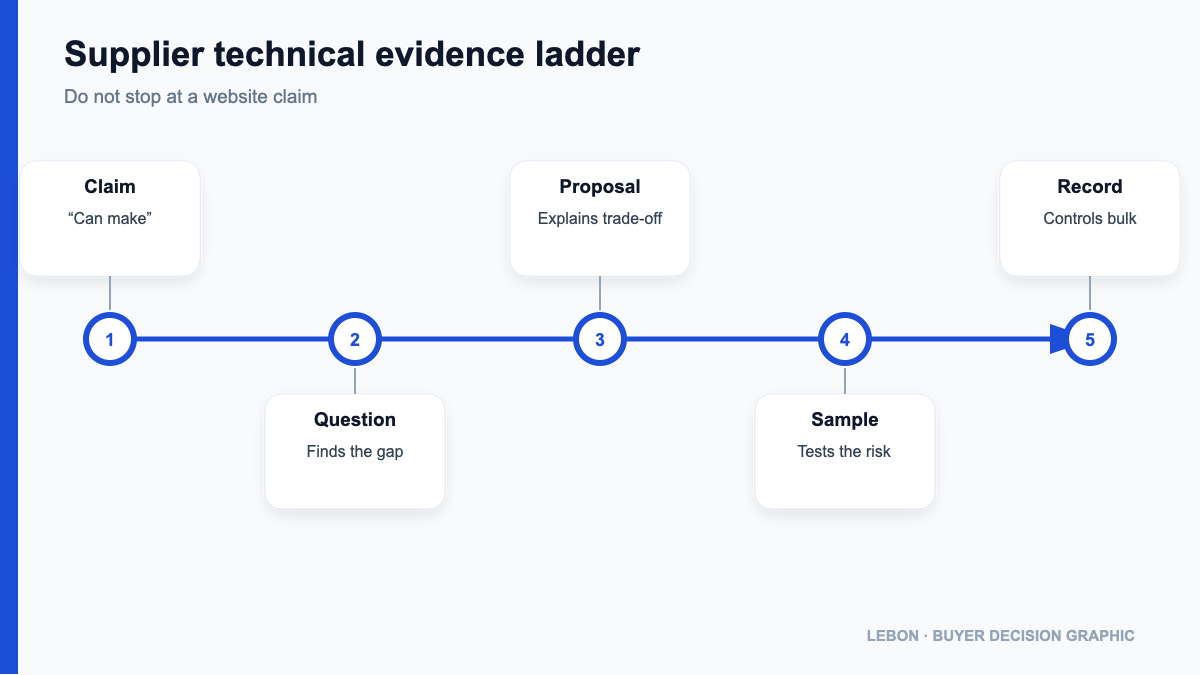
A useful technical response should show some combination of:
- questions tied to the bag’s intended contents, load and use condition;
- identification of missing measurements, material details or construction sections;
- recognition of conflicts between appearance and function;
- two or more viable options with clear trade-offs;
- an explanation of what must be proven during sampling;
- documented assumptions that can later be confirmed or replaced;
- a method for transferring the approved sample into production controls.
The supplier does not need to redesign the product. They do need to understand which unanswered decisions prevent a reliable quotation, sample or production release.
Five response tests that reveal technical understanding
1. Do they ask about use before choosing construction?
A laptop sleeve, a promotional drawstring bag and a loaded travel duffel should not be evaluated with the same construction logic. A supplier who understands the request may ask about device dimensions, access direction, expected load, carrying position, cleaning, weather exposure or retail presentation.
Those questions are useful because they connect specifications to function. A generic question such as “What quality do you want?” gives the buyer no decision framework.
2. Do they locate the exact unresolved detail?
Suppose a drawing shows a shoulder strap attached near a zipper opening. A technically useful reply might ask:
- Is the webbing captured in the main seam or attached to a separate reinforcement patch?
- Does the reinforcement continue under the lining?
- Must the zipper remain fully open while the bag is loaded?
- Is the strap position fixed from the bag edge or from the centerline?
The issue is not the number of questions. These questions identify load path, sewing sequence, opening distortion and measurement control.
3. Do recommendations include consequences?
“Use thicker fabric” is not enough. A recommendation should explain what problem it addresses and what else changes.
For example: adding body stiffness may improve shape retention, but it can increase seam bulk and change how a curved opening folds. Moving a logo to a flat panel may improve print consistency, but it changes the approved visual placement. Replacing a custom-colored component with a stock color may reduce sourcing complexity, but it requires an appearance approval.
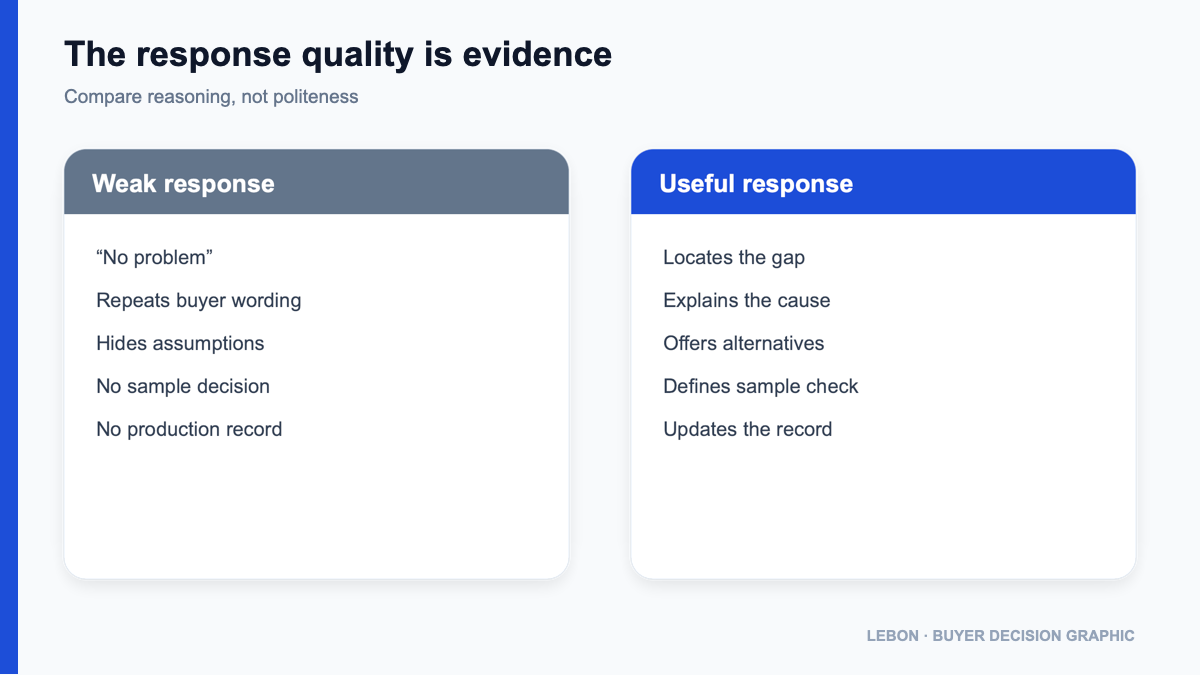
4. Do they distinguish a sample decision from a production decision?
An early prototype may use a substitute fabric or available hardware to check size and construction. That can be efficient if the substitutions are documented. It becomes dangerous when the buyer later assumes that the visual prototype is a production reference for color, hand feel, component finish or performance.
A capable supplier should state what the sample proves, what it does not prove and which items must be replaced or verified before pre-production approval.
5. Can they turn approval into a controlled record?
Verbal agreement is weak production input. After sample comments, the supplier should be able to update the drawing, measurement sheet, bill of materials, artwork reference or approval record. At minimum, the buyer and supplier need one identifiable version that represents the released product.
If a change appears only in a chat thread, ask how it will reach material purchasing, pattern making, sewing, inspection and packing.
A practical technical exercise for shortlisted suppliers
Choose one feature that matters to your product—for example a padded laptop pocket, reinforced carry handle, curved main zipper or printed front panel. Send the same files and questions to each supplier.
Ask them to return:
- the missing information they need;
- their proposed construction or material option;
- one alternative and its trade-off;
- what they would check on the first sample;
- what must be fixed before a production-representative sample;
- how the approved detail will be recorded for bulk.
This small exercise is more informative than asking whether they “can make” the product. Most suppliers can answer yes to a picture. Fewer can show how they will remove ambiguity.
How to score the response without creating false precision
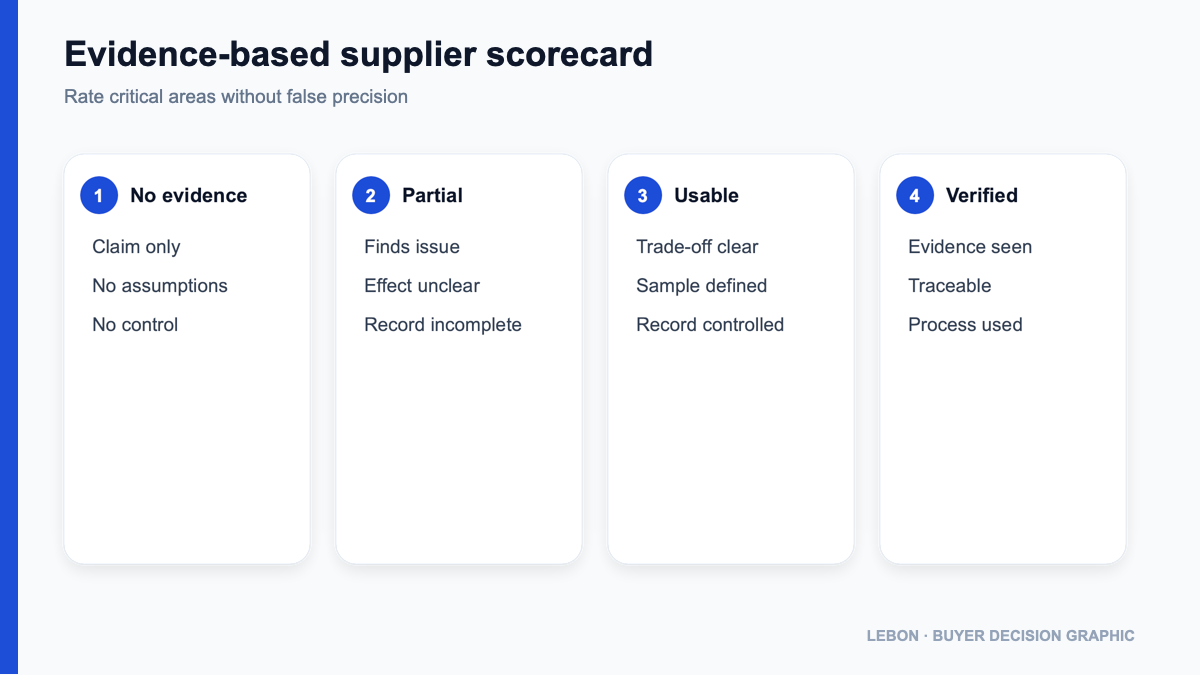
Do not give a supplier 87 out of 100 because a spreadsheet looks objective. Use an evidence-based rating for each critical area.
No evidence
- Repeats the buyer’s wording or says only “can do.”
- Does not expose assumptions.
- Gives no sample or production control.
Partial evidence
- Identifies a relevant issue but does not explain the effect.
- Offers an option without a decision criterion.
- Records some changes but leaves responsibility unclear.
Usable evidence
- Connects the issue to function or manufacturing.
- Provides a practical option and trade-off.
- Defines what the sample must prove.
- Records the approved decision in a controlled file.
Verified evidence
- The sample, relevant records or an audit demonstrates that the proposed control is actually used.
- The supplier can show traceability from requirement to purchasing, production or inspection for the item being evaluated.
Weight the areas according to the product. For a promotional pouch, artwork and packaging control may dominate. For a laptop backpack, dimensions, padding, carry structure and zipper access may be more important.
Red flags that need investigation, not instant assumptions
One weak answer does not automatically prove that a supplier is incapable. A salesperson may need support from a pattern maker or production engineer. The important question is whether the supplier can bring the right technical person into the review and return a controlled answer.
Investigate further when:
- every question is answered with “no problem” before the use condition is understood;
- the quotation contains no material or construction assumptions;
- the supplier recommends a change but cannot explain its effect;
- sample substitutions are not listed;
- approved changes remain only in chat messages;
- the supplier cannot identify which facility or process will make a critical feature;
- a certificate is presented as proof of product capability without checking its issuer, validity and scope;
- the response focuses on unit price while ignoring an obvious specification conflict.
Certifications, audits, samples and references provide different kinds of evidence. An ISO 9001 certificate may support confidence in a defined quality-management scope, but it does not by itself prove that a supplier can make your exact bag construction. Verify both the management system and the product-specific capability that matters.
Communication speed and technical capability are different
Fast communication is valuable, especially when approvals are time-sensitive. It should not replace technical review.
A supplier can be technically capable but slow or unclear in communication. That still creates project risk. Another supplier can communicate smoothly but fail to control materials or construction. Evaluate both dimensions separately:
- Technical fit: Can the team understand, sample, manufacture and inspect the required product?
- Project control: Can the team document decisions, manage revisions and communicate exceptions before they become surprises?
The best selection is usually not the factory with the strongest single dimension. It is the supplier whose combined evidence matches the risk of the order.
What buyers should send to make the evaluation fair
Supplier evaluation fails when each candidate receives different information. Prepare one dated package containing:
- product use and intended contents;
- drawings, dimensions and reference photos;
- material and hardware direction;
- logo and packaging requirements;
- quantity by style and color;
- required performance, testing or compliance information;
- target decision dates;
- open questions where supplier input is requested.
Tell suppliers which details are fixed and which can change. Otherwise, one supplier may faithfully quote a difficult feature while another silently redesigns it.
Next step for supplier evaluation
If you are comparing custom bag suppliers, send the product brief and the feature you consider highest-risk through our product inquiry form. Ask us to identify missing decisions, propose a sample check and record the assumptions behind the quotation. You can use the quality of that response as part of your evaluation.
Related resources:
- Cómo elegir una fábrica de bolsos personalizados
- Bag sampling and quality control process
- Desarrollo de bolsos personalizados and inquiry checklist
- Why bag factories quote different prices
Technical references: