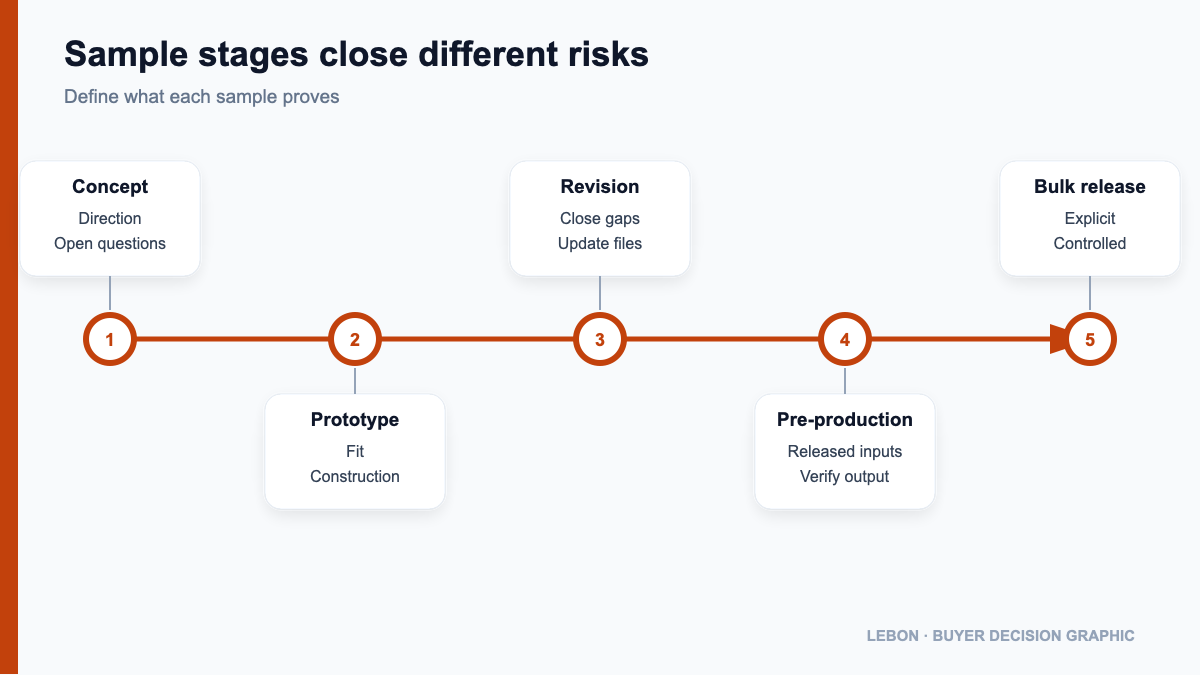
A prototype and a pre-production sample should answer different questions. The prototype helps the buyer and factory resolve the product: size, access, structure, construction and appearance. The pre-production sample is used to confirm that the resolved product is ready to be released under controlled materials, components, artwork and documents.
The terms are not used identically by every company. Some factories use “development sample,” “counter sample,” “approval sample,” “confirmation sample” or “golden sample” for overlapping stages. Do not approve based on the label alone. Define in writing what the sample contains, what it is intended to prove and whether approval authorizes bulk production.
Table of Contents
The difference is the decision being made
Prototype: resolve the product
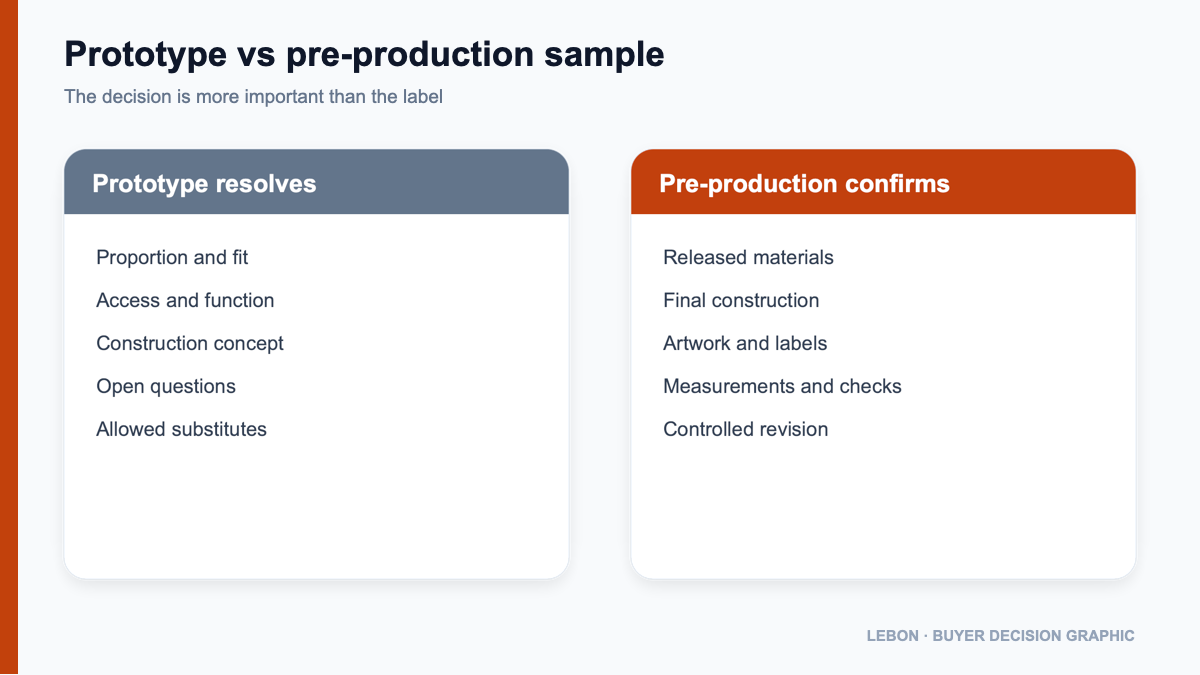
A prototype is normally used to explore or verify design decisions. Depending on the project, it may use available material, temporary hardware, simplified branding or hand-adjusted construction. Those substitutions can save time while the team checks:
- overall size and proportion;
- intended contents and fit;
- pocket access and organization;
- handle drop and strap adjustment range;
- opening geometry and zipper operation;
- padding, stiffness and shape;
- construction feasibility;
- visual placement of features;
- which requirements remain open.
The prototype is not poor quality simply because a declared substitute is used. The risk appears when the substitute is not recorded or when the buyer approves attributes the prototype was never intended to represent.
Pre-production sample: confirm the released product
A pre-production sample should represent the approved product specification closely enough to support a production-release decision. The buyer should expect the intended material and component specifications, approved colors and artwork, resolved construction, current measurements, labels and relevant packaging details unless an exception is documented.
It should be linked to a dated revision. If anything is still substituted or pending, list it and decide whether the remaining risk is acceptable before authorizing bulk.
“Same as sample” is not a complete instruction. The sample and the production documents need to agree.
What each sample should and should not approve
Approve on a prototype when represented
- silhouette, proportion and capacity direction;
- location and usability of pockets and openings;
- construction concept;
- carrying configuration and access sequence;
- appearance direction;
- changes required for the next revision.
Do not approve from a prototype unless verified
- exact bulk material color and hand feel;
- final zipper, buckle, hook or hardware finish;
- final logo appearance;
- production measurement tolerance;
- production packaging and labels;
- performance results for a different material or construction;
- bulk production release.
Approve on a pre-production sample when represented
- released material and component specifications;
- final construction and reinforcement details;
- finished measurements under the defined method;
- artwork method, color, scale and placement;
- labels, barcode content and packing presentation;
- functional checks and required test evidence;
- the document revision used for production.
Do not approve when an unresolved exception changes risk
If the pre-production sample uses a temporary zipper, substitute foam or unapproved print because the final material is unavailable, decide what that exception affects. A different zipper may change operation and appearance. Different foam may change dimensions and shape. A substitute logo process cannot approve the final logo result.
The buyer may authorize a limited next step, such as material booking, without authorizing full production. Record exactly what is released.
Why buyers accidentally approve bulk too early
The sample looks right, so hidden details are assumed
An exterior review may not reveal internal reinforcement, backing material, seam allowance, adhesive, stitch access or edge treatment. Use construction records and, when appropriate, an open section or separate construction mock-up.
A substitute is described only in a message
Later team members may see the physical sample but not the message. Put substitutions on the sample card and in the sample report or specification.
Changes are approved but the files are not synchronized
The sample maker may have followed chat comments that never reached the drawing or bill of materials. The physical sample becomes correct by memory while the bulk package remains wrong.
Approval language is vague
“Looks good” might mean approve color, approve shape or approve production. Use attribute-level approval:
- approved for size and construction;
- color not approved;
- logo placement approved, print result pending;
- packaging not reviewed;
- not approved for bulk production.
A change after the pre-production sample needs a new decision
Not every small change requires rebuilding the entire bag, but every change needs an impact review.
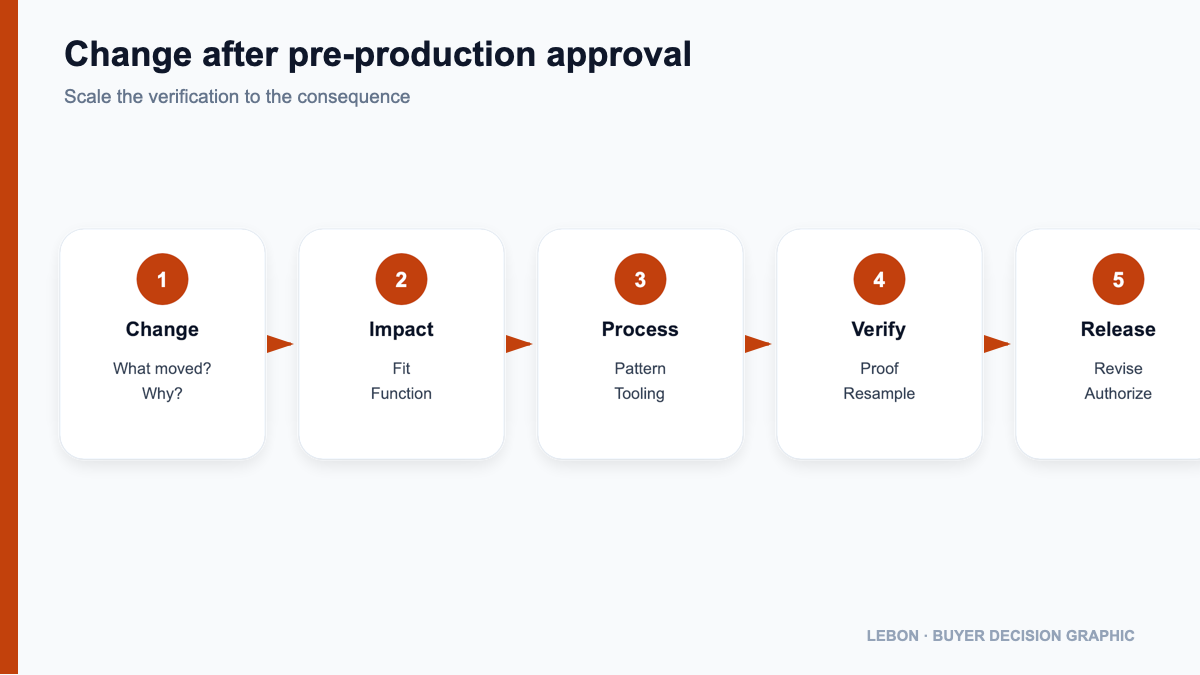
Ask four questions:
- Does the change affect fit, function, safety, compliance or a critical appearance requirement?
- Does it change material, pattern, tooling, artwork, assembly sequence or inspection method?
- Can the effect be verified with a component sample or partial mock-up, or is a complete sample required?
- Which documents and approvals must be revised before production continues?
Changing a hangtag text may require only artwork proof and document update. Moving a handle attachment can change load path, pattern, reinforcement, sewing sequence and measurements. Treating both changes as equal wastes time; treating both as harmless creates risk.
What is a golden sample?
“Golden sample” is often used for a retained, approved reference. Its authority must still be defined.
Identify the sample with product code, color, revision, approval date and sign-off. Record any limitations. Store it so that production and inspection teams can access an equivalent reference without damaging the only approved unit.
A golden sample is most useful for aspects that are difficult to communicate completely in words or numbers, such as shape, hand feel or workmanship appearance. It should not override a newer controlled specification, hide unapproved substitutions or replace measurable requirements.
A practical approval sheet for each stage
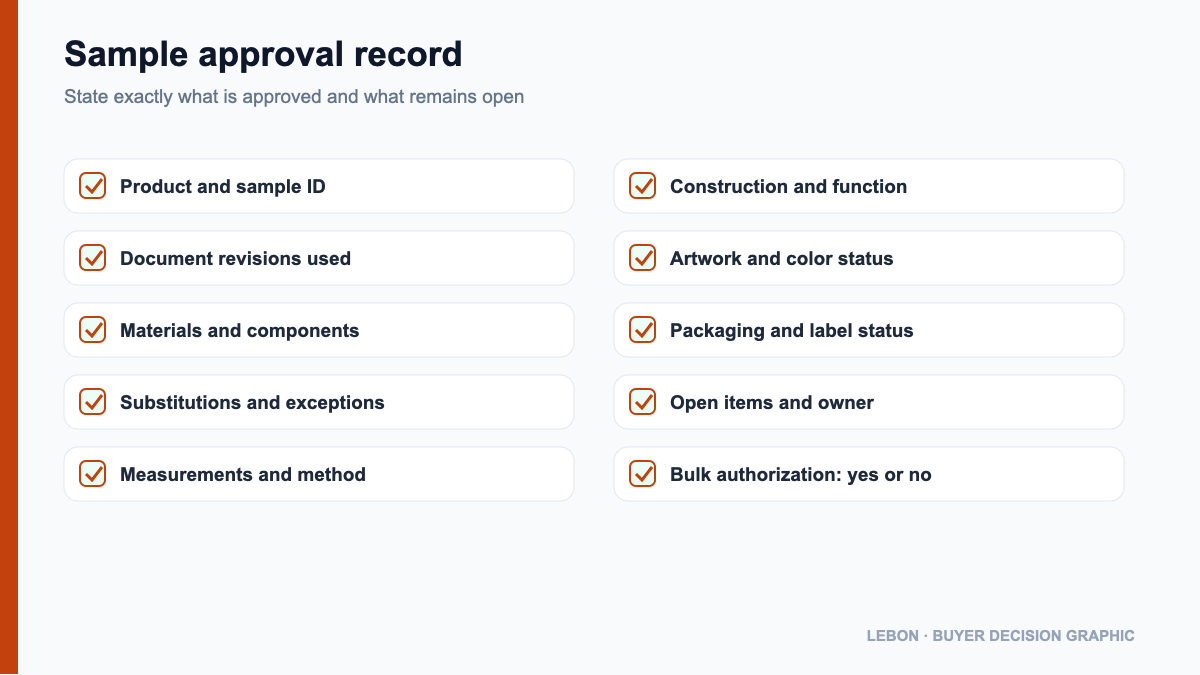
For every submitted sample, record:
- product code, color and size or style;
- sample type as defined by the project;
- sample number and date;
- drawing, BOM, measurement and artwork revisions used;
- materials and components used;
- every substitution or exception;
- dimensions measured and method used;
- construction and functional checks completed;
- required test status;
- packaging and label status;
- approved attributes;
- rejected or open attributes;
- next action, owner and due decision;
- whether bulk production is authorized.
This record prevents a buyer’s approval of one attribute from being interpreted as approval of the complete product.
How many sample rounds should a bag need?
There is no honest universal number. A straightforward design based on a proven construction may resolve quickly. A new structured shape, unusual material, difficult opening, load-bearing feature or regulated requirement may need separate experiments and more than one full revision.
Do not set the target as “one sample.” Set it as “the fewest samples needed to close the defined risks.” Small construction mock-ups, material swatches, print strike-offs and component samples can answer some questions without remaking the entire bag.
The buyer can also reduce unnecessary rounds by returning consolidated comments with clear priorities, dimensions and annotated photos. Conflicting comments from different stakeholders create avoidable revisions.
What buyers should specify before each sample request
For a prototype, send:
- the decision the prototype must support;
- fixed requirements and open questions;
- allowed substitutions;
- intended contents, load and use condition;
- measurements and features that must be checked;
- the format for sample comments.
For a pre-production sample, send or confirm:
- the production-release document revision;
- approved materials, components and colors;
- final artwork and labels;
- measurement method and acceptance criteria;
- required functional or laboratory checks;
- packaging specification;
- any remaining exception and its approval path;
- explicit authority required to begin bulk.
Next step before bulk production
If you are unsure whether the current sample is a design prototype or a production-release sample, send the sample record, current tech pack and list of substitutions through our product inquiry form. We can help separate what has already been approved from what still needs verification before bulk.
Related resources:
- Bag sampling and quality control process
- Why a bag drawing is not enough for production
- Desarrollo de bolsos personalizados and inquiry checklist
- Cómo elegir una fábrica de bolsos personalizados
Technical references:
- ASQ supplier evaluation methods, including prototyping and validation
- Schaeffler supplier guidance on production-process and product approval
- NORMA Group supplier quality manual on prototype and pre-production control