A good bag drawing can define shape, proportion, feature location and design intent. It still may not tell a factory which fabric to buy, how a seam is built, where a dimension starts and stops, what a sample is allowed to substitute, or which revision is approved for bulk.
That is why two sample makers can interpret the same drawing differently. They are not necessarily ignoring it. They are resolving decisions the drawing leaves open.
Use a drawing to show the product. Use a controlled technical package to tell quotation, sampling, purchasing, production and inspection teams how the approved product is defined. The package does not need to be complicated, but every decision that affects fit, function, appearance, cost or compliance needs an owner and a record.
Table of Contents
What a drawing communicates—and what it usually leaves open
An exterior front, back and side view is useful. It can show pocket position, panel shape, logo location and general proportions. It usually cannot show every hidden layer, component specification, measurement method or assembly decision.
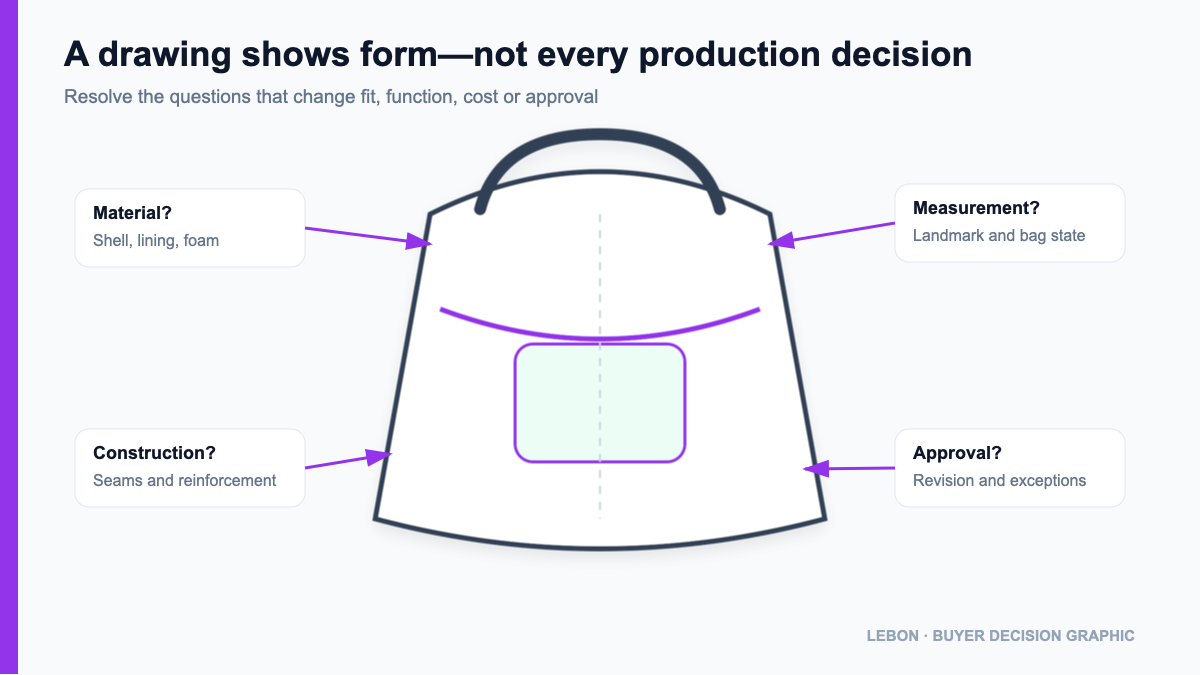
Common open items include:
- shell and lining material construction, weight, coating, color and approved alternative;
- foam, board, reinforcement and adhesive hidden between layers;
- zipper chain, slider, puller, stops and finished length;
- buckle, hook, ring and webbing specifications;
- seam, binding, edge finish, stitch and reinforcement construction;
- finished dimensions and exact points of measure;
- allowable variation and the condition in which the bag is measured;
- artwork file, method, scale, color and placement reference;
- label, barcode, packaging and carton requirements;
- sample substitutions and unresolved approvals;
- file revision and effective date.
The more structured or performance-sensitive the bag, the more risky it is to leave those details inside a reference sample, chat thread or designer’s memory.
The production definition has several connected layers
Think of the product as a stack of controlled information rather than one perfect drawing.
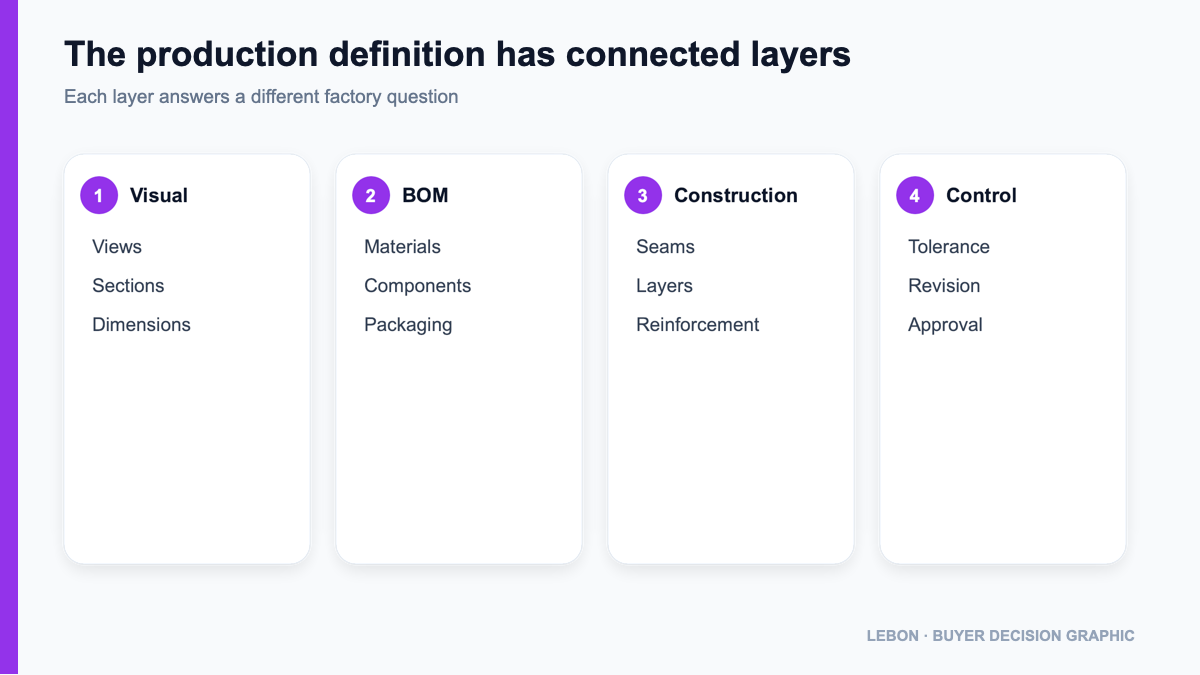
Visual and dimensional layer
Show views, sections, feature locations, finished dimensions and measurement landmarks. For soft bags, define whether measurements are taken flat, naturally filled, supported or under another agreed condition.
Bill of materials
List the materials, components and relevant identifying details needed to make and pack the bag. A manufacturing bill of materials is more than a shopping list; it connects the product definition to sourcing and production.
If an item may be substituted during the first prototype, mark both the intended item and the temporary substitute. Do not let the substitute quietly become the bulk specification.
Construction details
Use section drawings, callouts, photos or approved physical references to define details that an exterior view cannot show. Examples include:
- how a handle load is transferred into the body;
- where foam and reinforcement start or stop;
- how an internal seam is bound;
- how a pocket opening is finished;
- how lining is controlled beside a zipper;
- which side of a component faces outward;
- the order of overlapping layers at a seam intersection.
Artwork and appearance references
Provide usable artwork, color references, size, location and process. A logo shown on a rendering does not define print separations, thread colors, embossing depth or acceptable appearance. Those requirements need the production method and an approval reference.
Quality and packaging requirements
Define measurement checkpoints, visual requirements, functional checks, test methods where needed, packing materials, labels and carton marks. Inspection cannot verify a requirement that exists only as an expectation.
Revision and approval status
Every page or controlled package should identify the product, revision and date. The team also needs to know whether the file is for quotation, prototype, revision review or bulk release.
When a drawing is enough—and when it is not
A drawing may be enough for an exploratory discussion or a rough budgetary quotation if both parties clearly record the assumptions. It can also be enough to start a concept prototype whose purpose is to explore shape or construction.
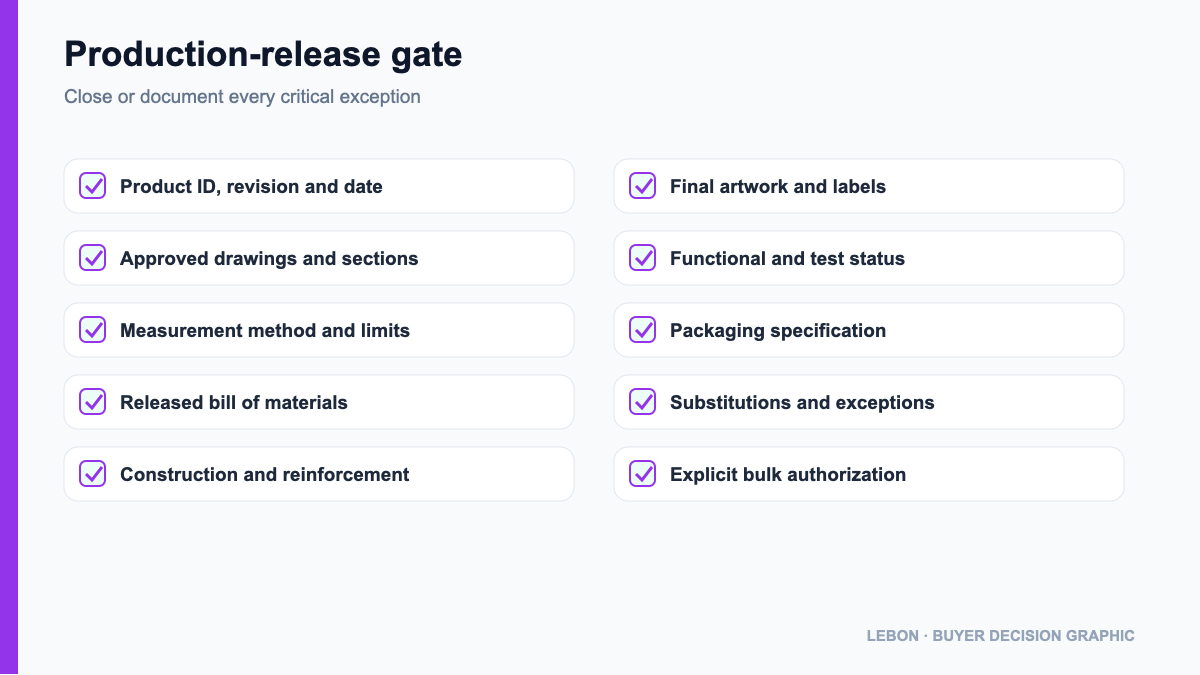
It is not enough to release mass production when important material, measurement, construction, artwork, packaging or quality decisions remain undefined.
Use these release labels to prevent confusion:
Concept reference
- Communicates design direction.
- Open details are expected.
- Not a firm production specification.
Quotation package
- Defines enough scope for a comparable price.
- Lists assumptions and exclusions.
- May still contain sample-stage decisions.
Prototype package
- Defines what the prototype must test.
- Identifies allowed substitutions.
- Records open questions for the next revision.
Production-release package
- Reflects approved materials, construction, measurements, artwork and packaging.
- Identifies the approved sample or reference where applicable.
- Includes a controlled revision and documented exceptions.
Why revision control matters after the sample looks correct
Imagine that the buyer approves three changes after the first sample: move the logo, lengthen the strap and add reinforcement under the handle. The drawing is updated for the logo, the measurement sheet is updated for the strap, and the reinforcement remains only in an email.
The approved sample may look correct because the sample maker remembers all three changes. Bulk production can still follow inconsistent records.
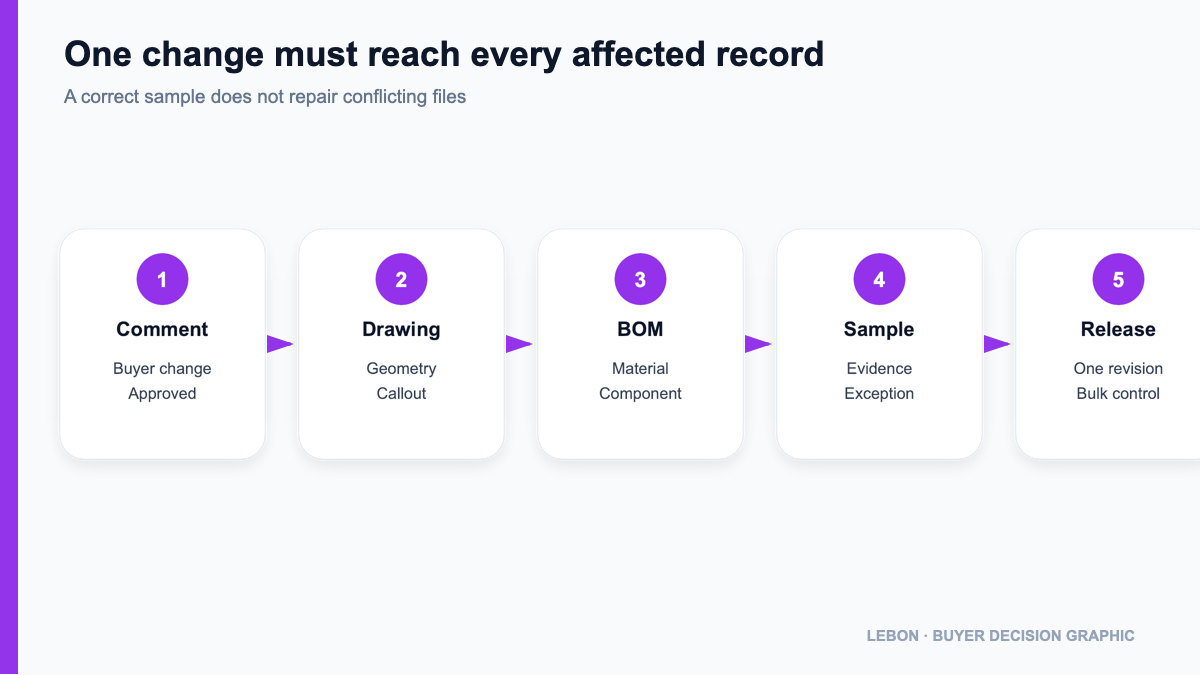
Use one change log with:
- revision number and date;
- exact item changed;
- old and new requirement;
- reason or decision reference;
- affected drawing, BOM, measurement, artwork or packaging page;
- approval status;
- person or function responsible for release.
When a material change affects construction or appearance, update all connected sections. Replacing a thick foam with a thinner option can change dimension, seam bulk, shape and protection. Updating only the BOM leaves the rest of the package internally inconsistent.
The minimum useful bag production package
There is no universal page count. A simple pouch may need a short package; a structured travel bag with multiple compartments needs more. The minimum useful content is determined by risk, not by template length.
For most custom bag projects, include:
- Cover and revision page: product ID, name, revision, date, stage and contacts.
- Visual views: front, back, sides, top, bottom and relevant interior views.
- Measurement sheet: points of measure, target, method and tolerance or approval status.
- Bill of materials: shell, lining, foam, reinforcement, zipper, hardware, webbing, labels and packaging.
- Construction pages: cross-sections and callouts for critical seams, pockets, handles, straps and openings.
- Artwork package: source files, process, scale, colors and placement measurements.
- Functional requirements: intended contents, access, load, fit and any required checks or tests.
- Packaging specification: unit packing, labels, barcode data, carton and shipping marks.
- Sample comments and approval record: what changed, what remains open and what the current sample proves.
Common mistakes when turning design into production information
Using material marketing names as specifications
Words such as “premium,” “durable,” “waterproof” or “eco-friendly” do not tell purchasing what to buy or quality control what to verify. Define the material and the claim separately. If a performance claim requires testing or certification, identify the evidence before publication or production.
Measuring from an unclear landmark
“Pocket 80 mm from side” is ambiguous if the side is curved, bound or compressed. Show the start and end points on a view and define the bag condition during measurement. Do not publish a universal numeric tolerance for all points; set one based on function, construction, material behavior and agreed measurement method.
Treating a photograph as the only construction record
A photo can clarify appearance, but it may hide internal reinforcement or seam order. Use annotated photos alongside written or sectional construction information.
Mixing fixed requirements with factory proposals
If every line looks equally final, the supplier may not know which details can be optimized. Label requirements as fixed, proposed, approved alternative or open.
Releasing the sample without releasing the documents
The phrase “same as approved sample” is useful only when the sample is identifiable, retained and supported by current specifications. A physical sample can age, become damaged or fail to show hidden materials. Keep the document set authoritative and use the sample as one approval reference.
What if you do not have a complete tech pack?
Do not delay the first conversation until every answer is known. Send what you have and separate three categories:
- Fixed: decisions the factory must follow;
- Open: decisions that require development;
- Proposed: your current direction, where alternatives are welcome.
Ask the manufacturer to return an assumption register before quoting or sampling. That lets you see which gaps affect price, construction and approval. It is better than allowing decisions to remain invisible.
Next step for product development
If you have a bag drawing but not a production-ready specification, send the drawing, intended use, dimensions, quantity direction and reference details through our product inquiry form. We can identify which decisions must be resolved for quotation, which can be tested during prototyping and which must be locked before bulk.
Related resources:
- Développement de sacs personnalisés and inquiry checklist
- Custom bag materials guide
- Bag sampling and quality control process
- Prototype vs pre-production sample
Technical references:
- PTC explanation of a manufacturing bill of materials
- SAP guidance on linking revision levels to controlled changes
- ISO 9001 guidance on documented information